05 — Results
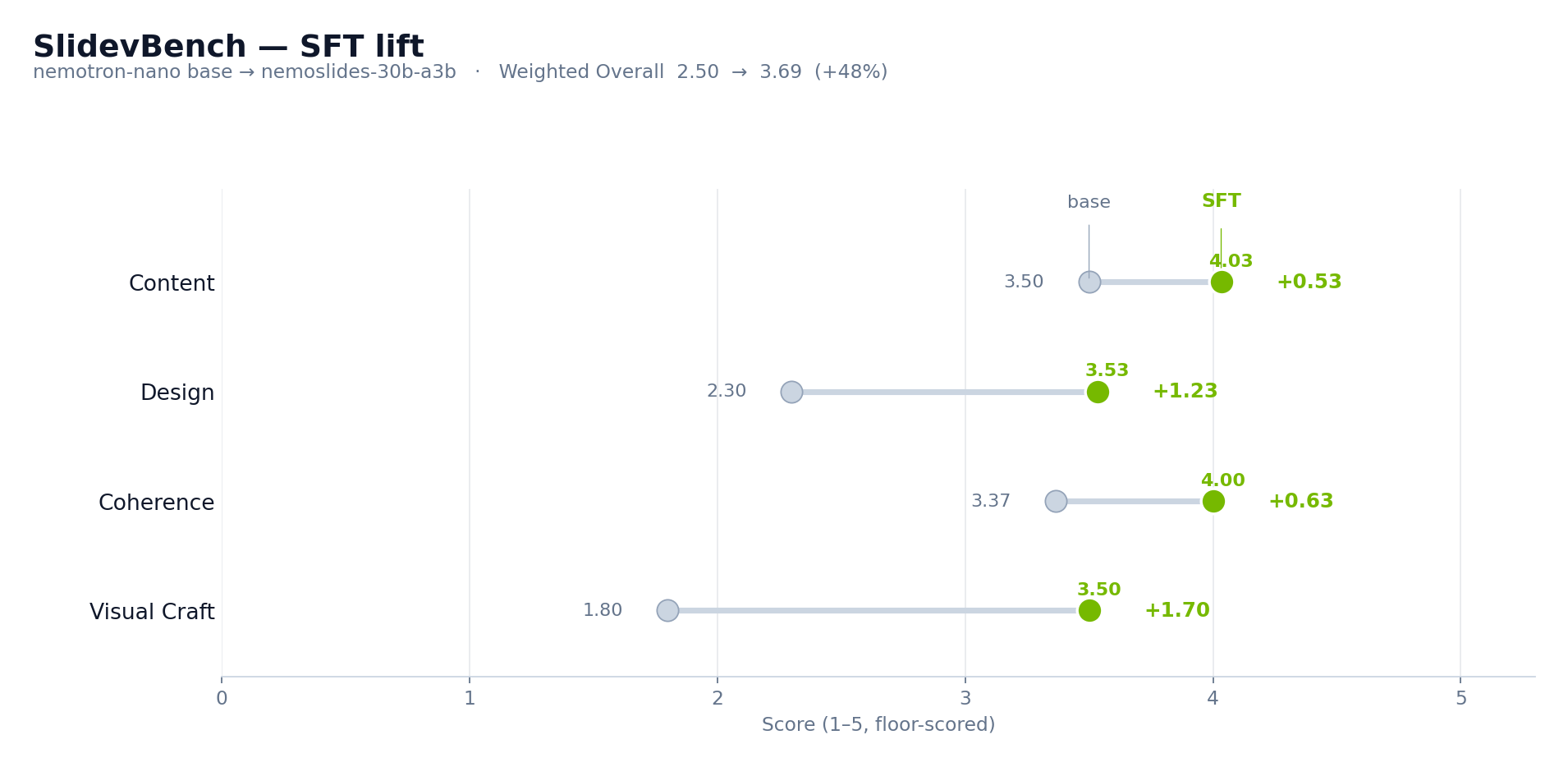
nemoslides-30b-a3b ranks #1 on SlidevBench at 3.69 floor-scored Overall — ahead of gpt-5.4, glm-5.1, and the 120B-A12B nemotron-super. Δ versus the base nano: +48% Overall (2.50 → 3.69), with the largest per-dimension gains on Design (+1.23) and Visual Craft (+1.70). Render rate improved from 87% to 93%.
Headline
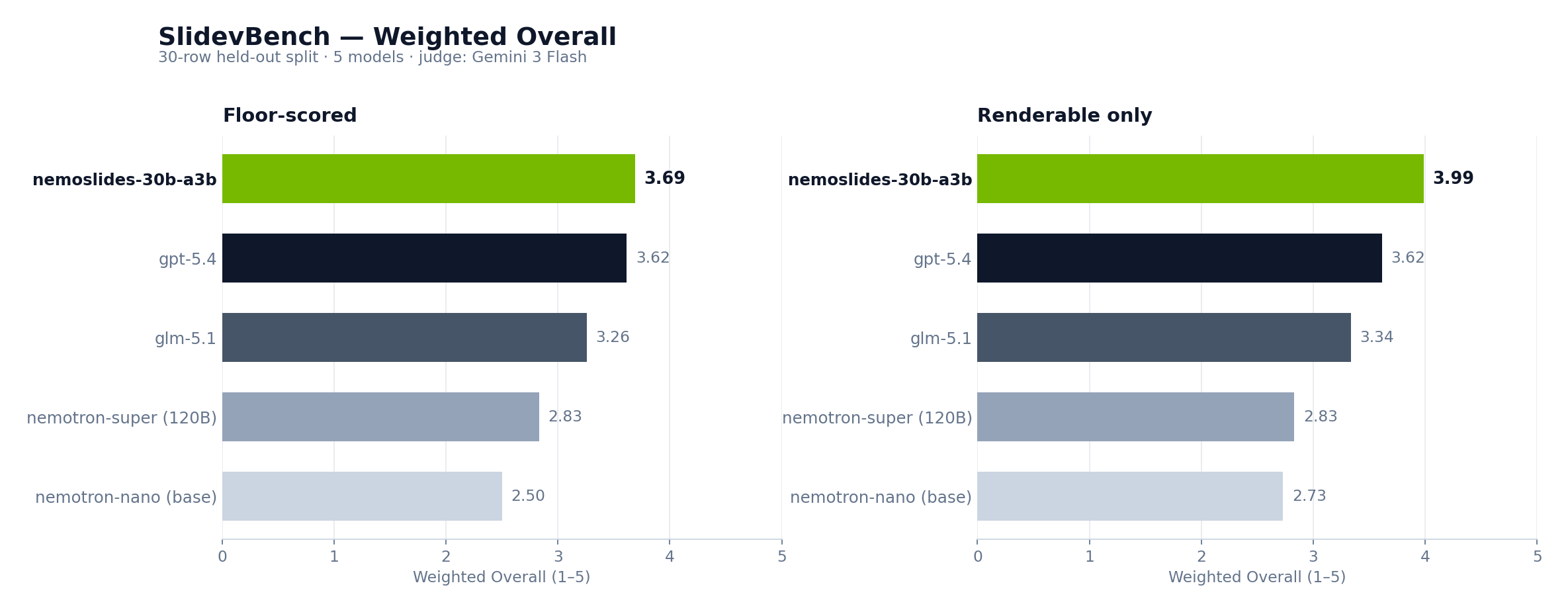
30 held-out prompts. Judge: google/gemini-3-flash-preview (vision). SlidevBench rubric per 04 · Evaluation.
Floor-scored (the headline)
Unrenderable rows count as 1 across all four dimensions.
| Model | Render | Content | Design | Coherence | VisCraft | Overall |
|---|---|---|---|---|---|---|
| NemoSlides (30B SFT, ours) | 93% | 4.03 | 3.53 | 4.00 | 3.50 | 3.69 |
gpt-5.4 |
100% | 4.27 | 3.17 | 4.07 | 3.40 | 3.62 |
glm-5.1 |
100% | 3.83 | 3.03 | 3.83 | 2.90 | 3.26 |
nemotron-super (120B-A12B) |
100% | 4.13 | 2.63 | 3.73 | 1.97 | 2.83 |
nemotron-nano (30B-A3B, base) |
87% | 3.50 | 2.30 | 3.37 | 1.80 | 2.50 |
Mean-over-renderable (secondary view)
When restricted to decks that rendered successfully, NemoSlides pulls further ahead.
| Model | Render | Content | Design | Coherence | VisCraft | Overall |
|---|---|---|---|---|---|---|
| NemoSlides | 93% | 4.37 | 3.81 | 4.33 | 3.78 | 3.99 |
gpt-5.4 |
100% | 4.27 | 3.17 | 4.07 | 3.40 | 3.62 |
glm-5.1 |
100% | 3.93 | 3.10 | 3.93 | 2.97 | 3.34 |
nemotron-super |
100% | 4.13 | 2.63 | 3.73 | 1.97 | 2.83 |
nemotron-nano |
87% | 3.88 | 2.50 | 3.73 | 1.92 | 2.73 |
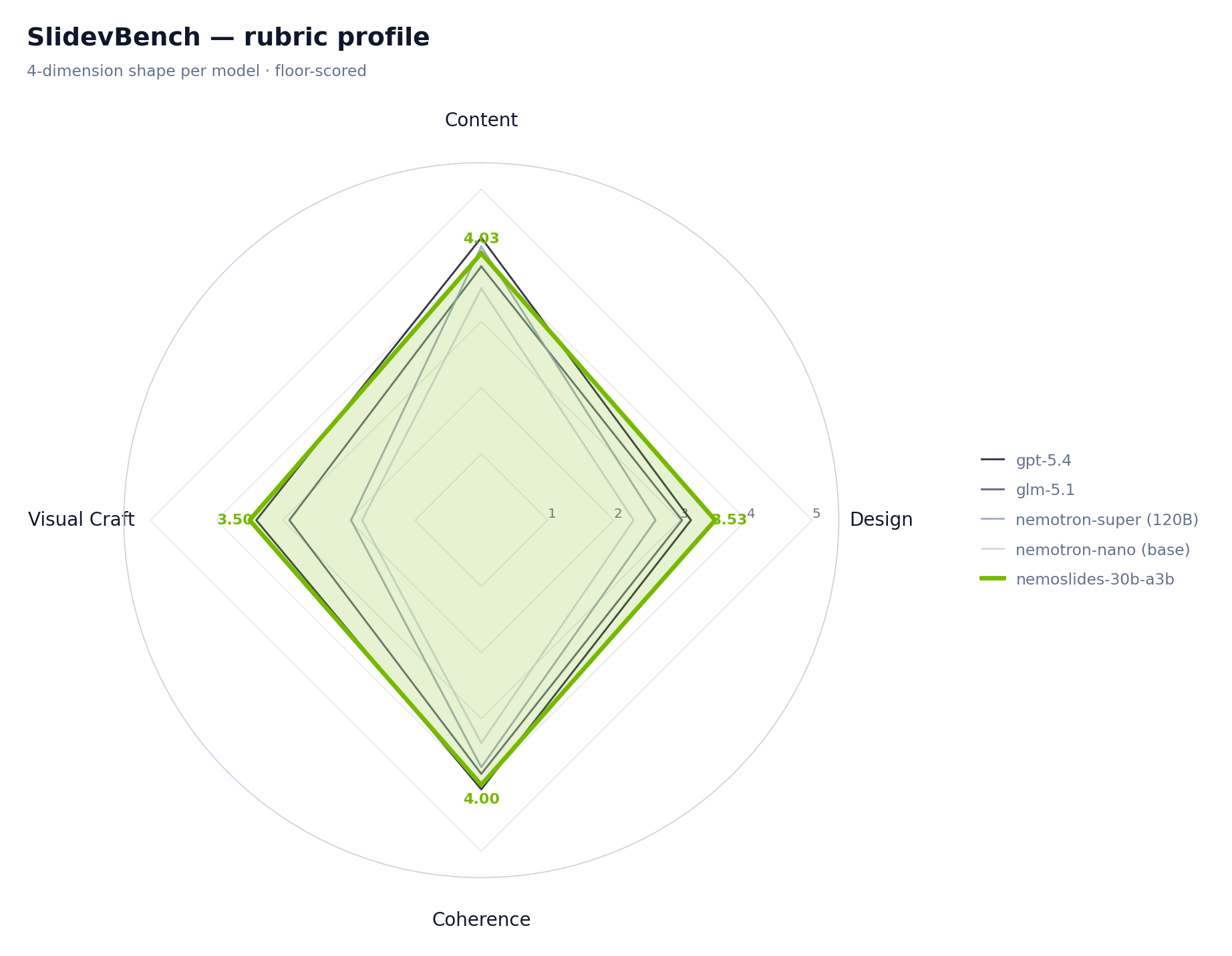
The finetuned 30B-A3B beats the 120B-A12B same-family sibling on every dimension under both views, and clears the closed frontier gpt-5.4 reference on the weighted Overall.
Per-dimension comparison
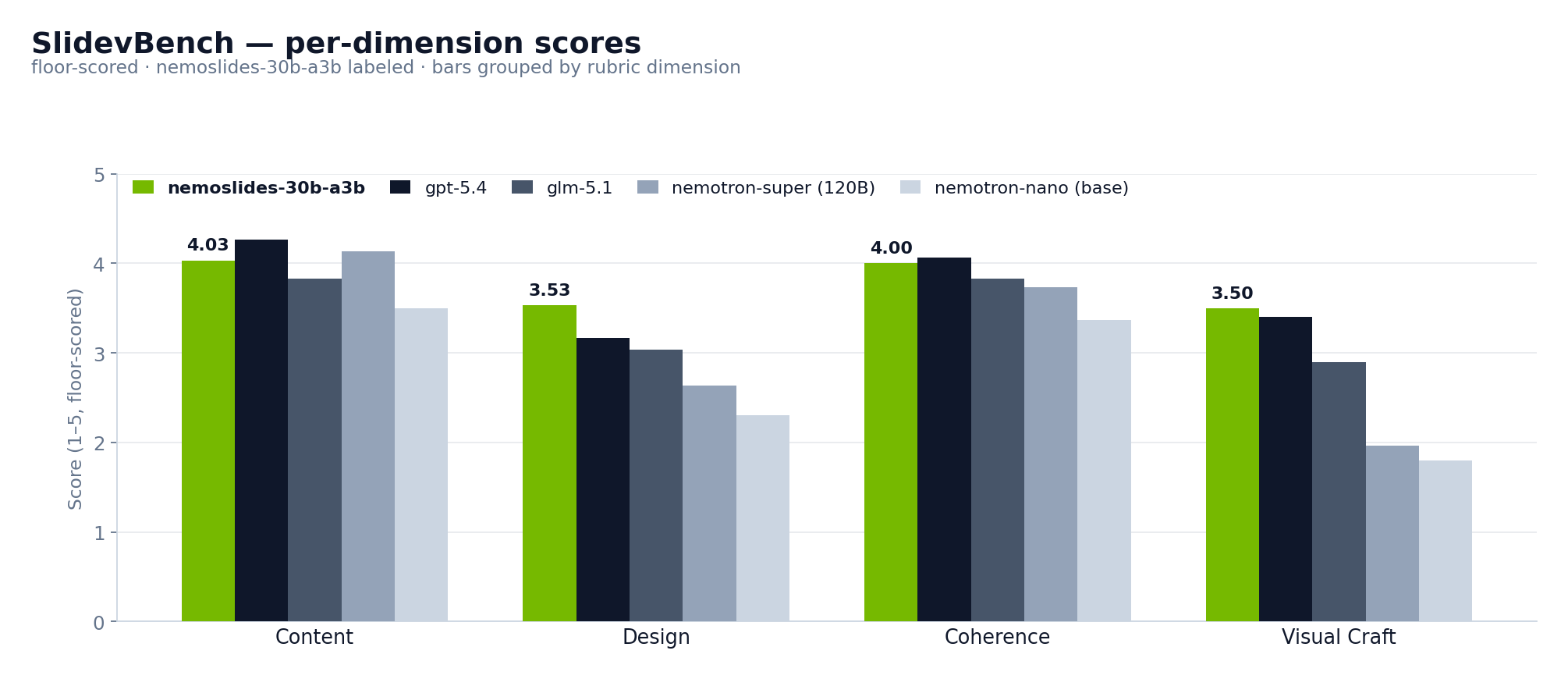
The Visual Craft dimension (objective feature scanner, un-gameable by the judge) carries the largest SFT gain. This is expected — the synthetic corpus is designed to teach the full Slidev capability surface, and the objective scanner is the dimension that surfaces exactly that coverage.
SFT delta
Per-dimension Δ, NemoSlides vs. nemotron-nano (base):
| Dimension | nemotron-nano |
NemoSlides | Δ |
|---|---|---|---|
| Content | 3.50 | 4.03 | +0.53 |
| Design | 2.30 | 3.53 | +1.23 |
| Coherence | 3.37 | 4.00 | +0.63 |
| Visual Craft | 1.80 | 3.50 | +1.70 |
| Overall (floor) | 2.50 | 3.69 | +1.19 |
| Overall (renderable) | 2.73 | 3.99 | +1.26 |
| Render rate | 87% | 93% | +6 pp |
Visual Craft is the largest gain. A base nano deck averages 1.80 feature-score; the finetuned model hits 3.50, approaching the closed frontier (gpt-5.4 at 3.40 and actually surpassing it). This is direct evidence that the SFT signal is doing what it was designed to do — teaching the model to reach for advanced Slidev features rather than defaulting to bullet-soup slides.
Design is the second-largest gain, confirming that the objective feature coverage translates into subjective visual quality as judged by the VLM. The two dimensions cross-check each other: a Δ on Visual Craft without a matching shift in Design would indicate the model is padding feature counts without producing coherent output; the parallel Δ rules that out.
Before / after on the same prompt
The same user prompt, same 30-row test split seed (seed_00010), rendered by the base model and by NemoSlides. Δ Overall on this seed: +2.60 (base 1.35 → NemoSlides 3.95).

nemotron-nano (base) · Overall 1.35 · invalid/hallucinated image

nemotron-nano slide 2

nemotron-nano slide 3
Gallery — NemoSlides on held-out prompts
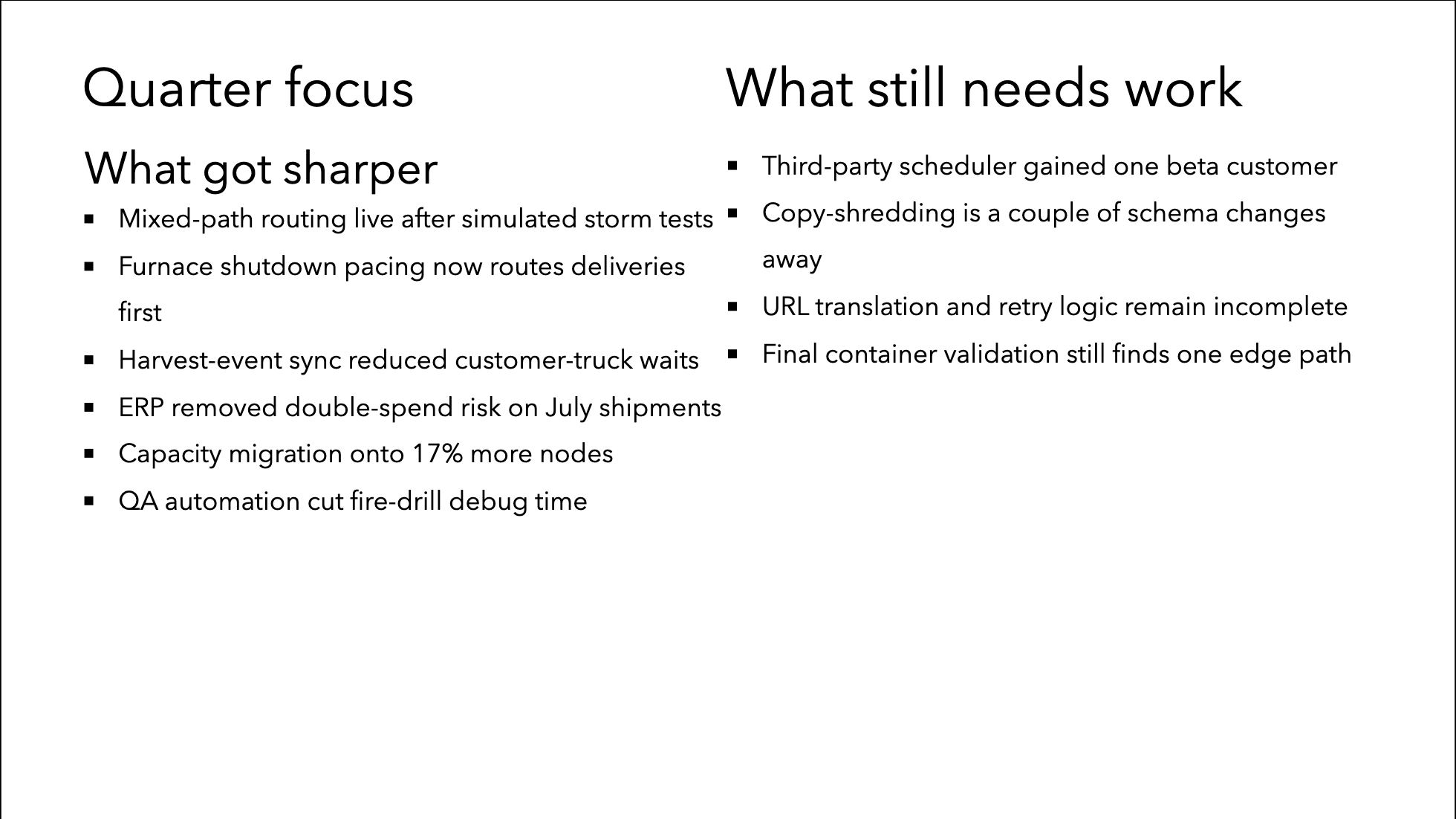
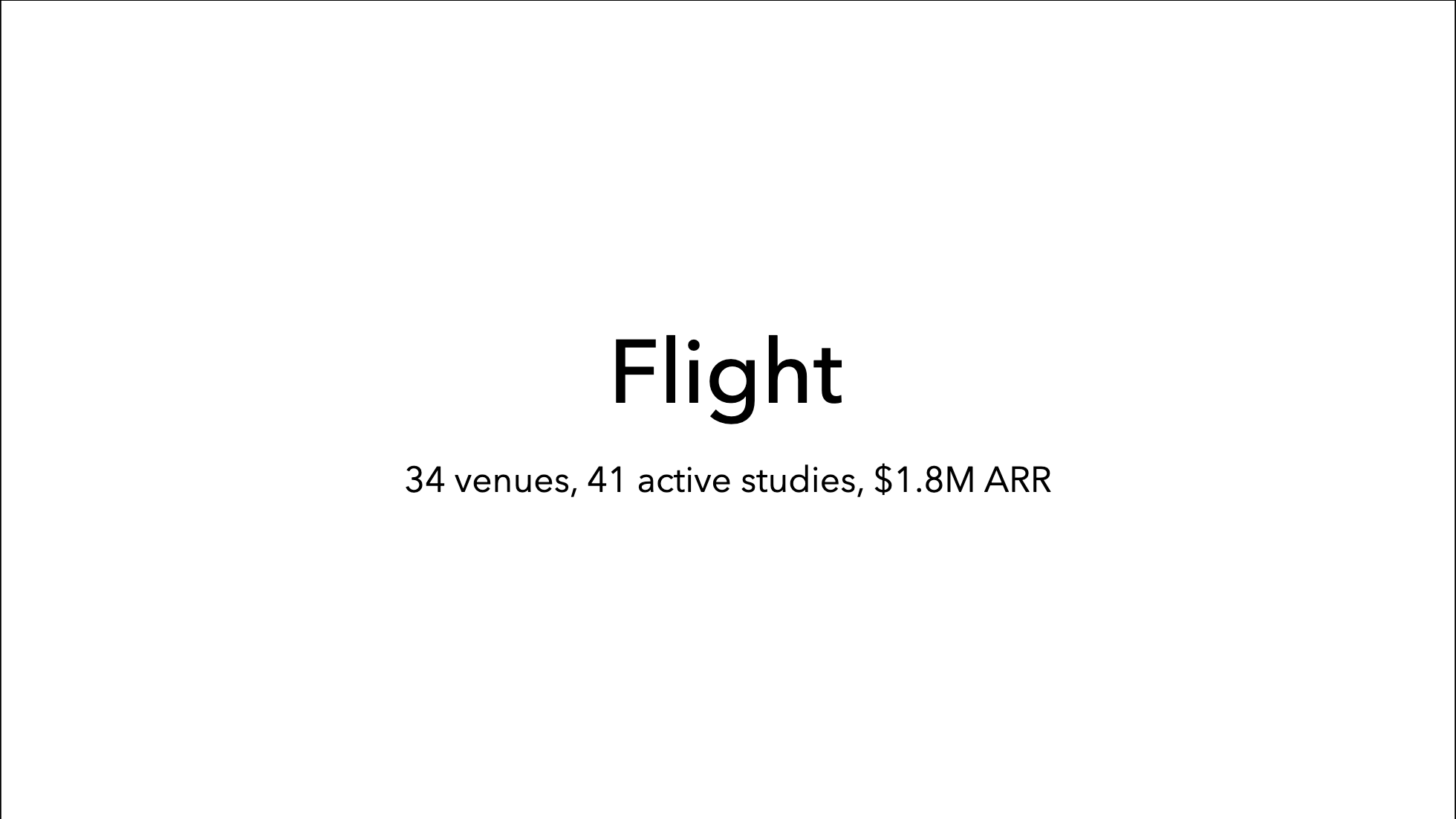
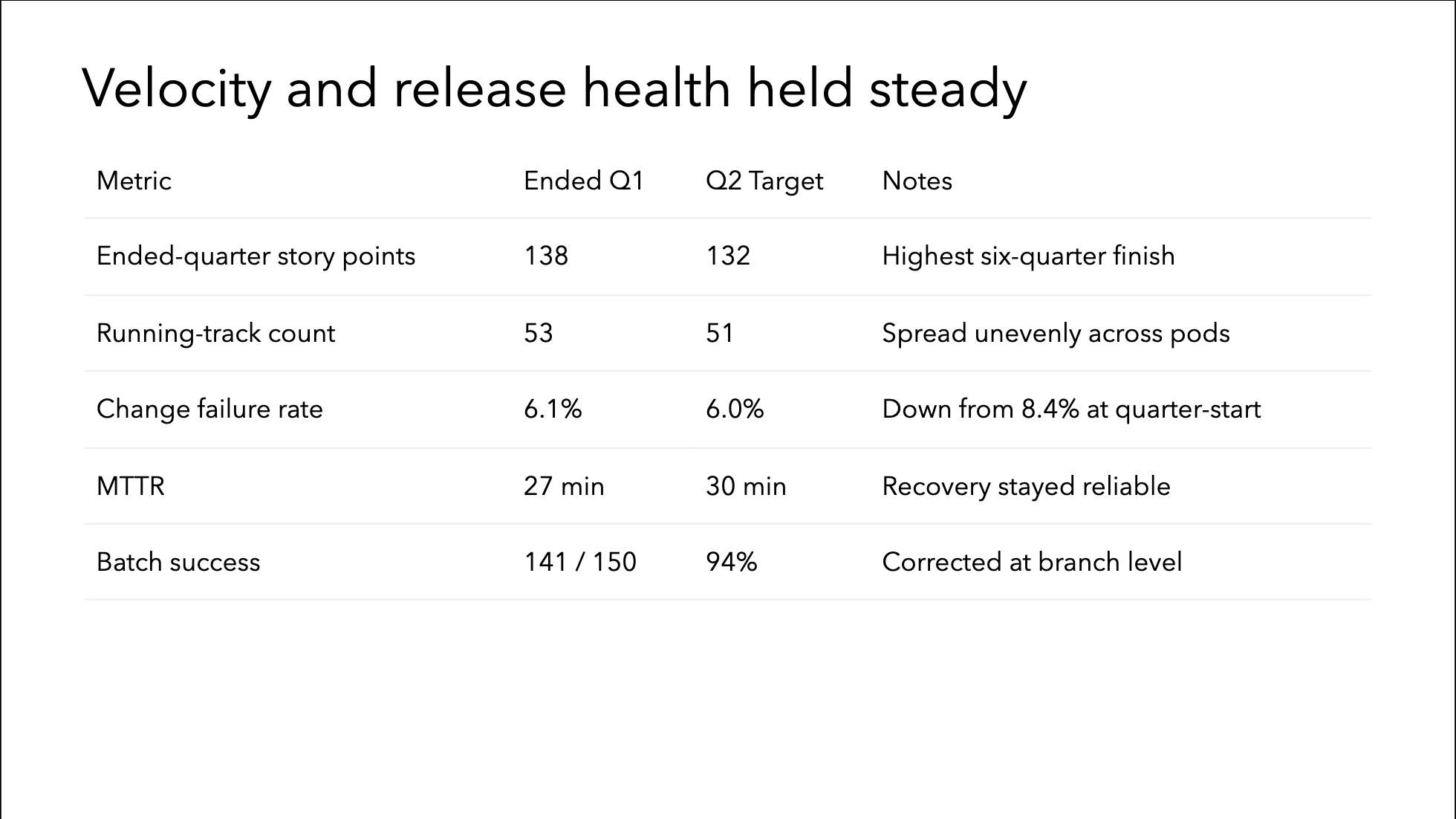
Rendered slides from NemoSlides on the 30-row test split, spanning the Slidev capability surface — covers, two-cols, image-right, fact, and mid-deck content layouts.





Human blindtest
The VLM fold above is cross-checked by a human pairwise preference study (protocol in 04 · Evaluation).
Status (2026-04-22): 90 head-to-head comparisons voted on the pre-training reference matrix (base nano / super / glm-5.1 / gpt-5.4 among themselves). The post-training queue — NemoSlides against each reference — is live; per-model win rates roll into this section as votes land.
Why a second fold. A capability Δ that appears only on a VLM judge but fails to reproduce under human pairwise preference is not a real Δ. A model that wins both folds is the only defensible claim — and the one this section will update to reflect.
Artifacts
- Full per-seed JSONs:
results/eval/runs/<model>/<seed>/score.json - Aggregated comparison:
results/eval/comparison.json·results/eval/comparison_table.md - Plots:
results/eval/plots/ - Rendered decks (all 5 models × 30 seeds):
results/eval/runs/ - Blindtest votes:
results/blindtest/votes.db